 splatvik
Hell Let Loose is the most ballistically honest shooter in its class. Bullets have mass, travel time and drop. Tanks have angled armour with genuine weak points. Engagements happen at ranges where the target is four pixels tall.
All of which means a cheat built for arena shooters is worse than useless here. This one was built for the ranges the game actually plays at.
What is in the build
| Module | Detail |
|---|---|
| Ballistic aimbot | Per-weapon drop and travel tables, hitbox selection, smoothing |
| Infantry ESP | Box, skeleton, health, distance, role icon |
| Armour ESP | Hull and turret orientation, weak points, crew count |
| Objective ESP | Garrisons, outposts, nodes, supply drops |
| Artillery calculator | Map click to elevation and traverse |
| FOV changer | Push past the in-game cap without HUD breakage |
| Stream proof | Invisible to OBS, Discord, ShadowPlay, Game Bar |
| Recoil & sway | Configurable reduction with per-weapon profiles |
The ballistic aimbot
This is the module the whole product is built around, so it is worth explaining properly.
In a hitscan shooter, an aimbot is a two-dimensional problem: point the crosshair at the target's screen position. In Hell Let Loose it is a physics problem. A K98k round leaves the barrel at roughly 760 m/s and drops under gravity for the entire flight. At 400 metres that is about 0.53 seconds of flight time and well over two metres of drop.
So the solve has four stages:
1. Range. Read the target's world position, subtract your own, take the magnitude. This is exact — no rangefinder estimation error.
2. Drop. Look up the muzzle velocity for your current weapon from the measured ballistic table, compute flight time for the range, and calculate the vertical drop over that time under the game's gravity constant. Offset the aim point upward by that amount.
3. Lead. Read the target's velocity vector. Multiply by flight time. Offset the aim point along that vector. This is what turns a miss behind a running target into a hit.
4. Apply. Feed the corrected aim point through the FOV gate, the visibility check and the smoothing curve before it becomes actual input.
The ballistic tables are measured, not calculated from published stats, because the published stats and the in-game behaviour do not always agree. They get re-verified after every patch that touches weapon handling, and re-verification is part of our release checklist rather than something we do when someone complains.
Iron sights change the solve. When you are aiming down a rear notch rather than a scope, the aim point that lands a hit is offset from the screen-centre crosshair. The build accounts for sight type per weapon — this is why a generic aimbot ported from another game misses constantly in HLL.
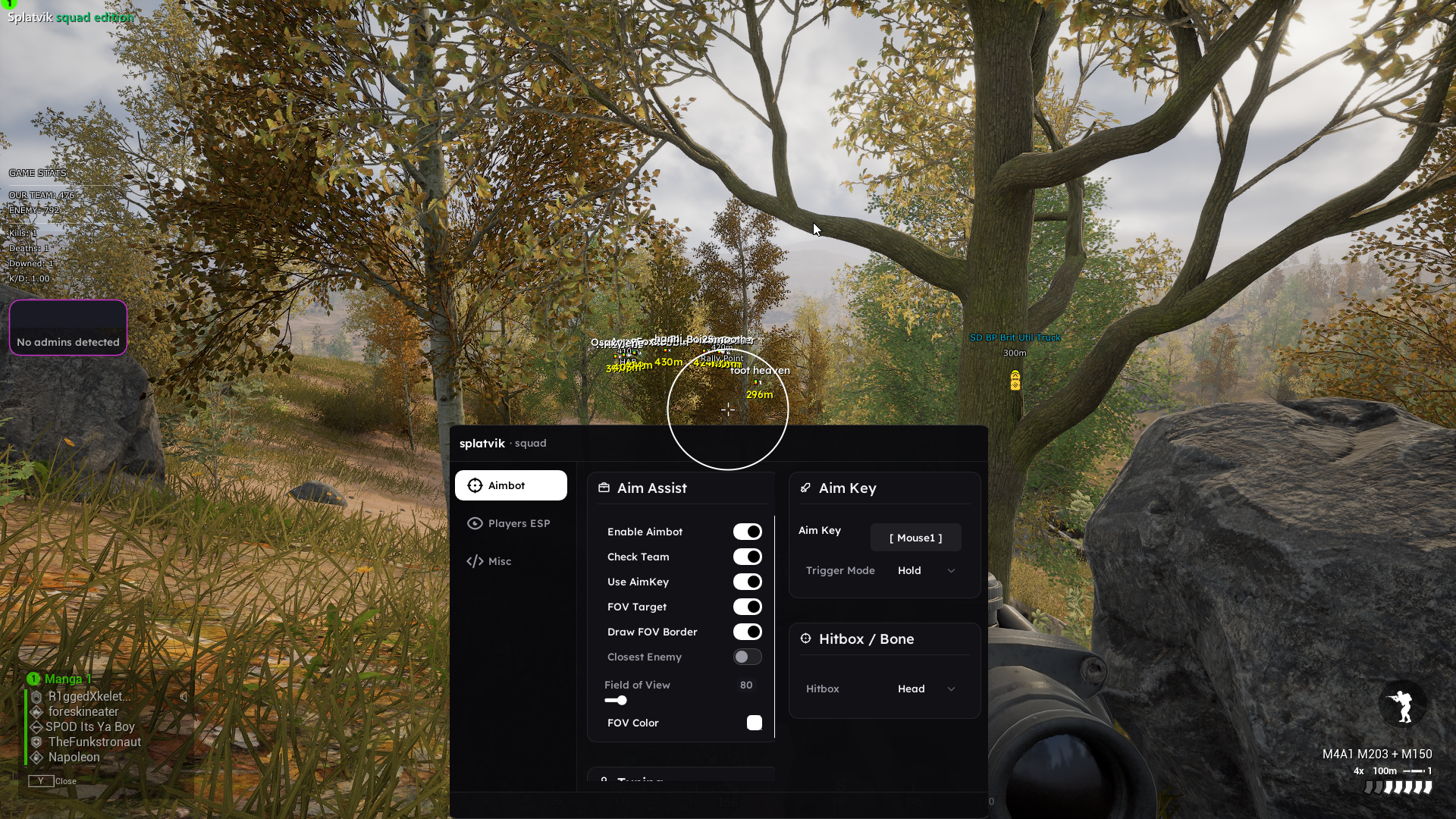
Aimbot settings for HLL specifically
| Setting | Recommended | Note |
|---|---|---|
| FOV | 5° | HLL engagements are long and deliberate. A wide FOV is instantly obvious. |
| Hitbox | Chest | Head hitboxes at 400m plus prediction error equals misses |
| Smoothing | 5.5 | Slower than a close-range shooter — matches the game's pace |
| Drop compensation | On | Non-negotiable past 150m |
| Lead | On | Non-negotiable against any moving target |
| Visibility check | On | Foliage in HLL blocks bullets. Respect it. |
Infantry and armour ESP
Infantry ESP draws role icons alongside the standard box and health. In HLL that matters more than in most games: knowing which of six approaching contacts is the machine gunner, and which is carrying the satchel that will delete your garrison, changes your target priority entirely.
Distance scaling is aggressive by default because engagements happen across the whole map. Skeletons draw under 120m, boxes under 500m, and labels under 900m. Past that you get a single dot.
Armour ESP is the module that most surprises people. For each vehicle it renders:
- Hull orientation and turret orientation as separate indicators
- Weak point markers for the current aspect (rear, engine deck, tracks, cupola)
- Crew count and role occupancy
- Ammunition state where the game replicates it
Knowing a Panther has its rear deck exposed and only a driver aboard turns an unwinnable engagement into a free kill with a satchel.
The artillery calculator
Artillery in Hell Let Loose is a two-value problem: elevation and traverse. Getting there normally involves a spotter, a map grid and a lot of arithmetic.
The calculator overlay converts a map click into the exact values for your gun, accounting for gun type and the range to target. It also shows the flight time so you can time a barrage against a moving push rather than an empty field.
This is arguably the least "cheat-like" module in the whole product — a good artillery crew with a paper table and a calculator arrives at the same numbers. It just does it faster.
Stream proof rendering
The overlay is excluded from capture by OBS, Discord screen share, NVIDIA ShadowPlay and Windows Game Bar. This is done at the window composition layer rather than by trying to detect and blank individual capture applications, which means it also covers capture tools we have never heard of.
We test this before every release with all four of the above running simultaneously. It is on by default.
Performance
| Scenario | Average FPS | 1% low |
|---|---|---|
| Clean game, 1440p high, 100-player Offensive | 88 | 64 |
| splatvik loaded, all modules on | 87 | 63 |
The overlay composites outside the game's render loop. The ballistic solve runs once per aim frame on a worker, and the ESP actor walk is throttled to 60Hz rather than running per frame, because infantry do not teleport.
Safety and updates
Hell Let Loose runs Easy Anti-Cheat. The build is manual-mapped, signature-randomised and HWID-locked. Nothing is written to game memory — the aim correction applies at input level.
When the game or EAC updates, the status page flips to Updating automatically from our dev channel, the loader refuses to inject, and sales pause. Downtime is credited to active subscriptions without you needing to ask.
Setup
- Disable Secure Boot (see the setup guide).
- Pause antivirus real-time protection.
- Run the loader as administrator.
- Paste your key — it binds to your hardware on first use.
- Launch the game, reach the main menu, press Inject.
- Insert opens the menu in-game.
Frequently asked questions
Does the aimbot really handle bullet drop? Yes, from measured per-weapon tables rather than a global constant. That is the entire point of the build.
Does it work with tank guns? Yes. Tank main guns have their own ballistic entries including shell type.
Can I stream with it on? Yes. Stream-proof rendering is on by default and covers the major capture paths.
Does the FOV changer get flagged? No — it changes a client-side rendering value that the server does not validate. It is one of the safest features in the product.
Which sights are supported? All of them: iron sights, scoped variants and the tank optics, each with the correct offset applied.
Live status, full feature list and current pricing on the Hell Let Loose product page.
Founder & lead developer — part of the splatvik team since 2023.
Related articles.
The complete Squad cheat guide: ESP, aimbot and staying invisible in 100-player servers
How the splatvik Squad build actually works — from the memory reads behind ESP to the smoothing curve that keeps your aim looking human on a 100-player server.
Dead by Daylight cheats explained: aura ESP, auto skill checks and how not to get reported
Dead by Daylight is an information game, and information is exactly what a cheat provides. Here is every module in the splatvik DBD build, how each one works, and the settings that keep you off the report radar.
ESP explained: what a wallhack actually reads, and why it barely costs any frames
A technical walkthrough of how ESP is implemented — actor lists, view matrices, world-to-screen projection and overlay compositing — written for people who want to know what they are actually buying.